Every roof reaches a point where patching it up costs more than it saves. The tricky part is knowing where that line sits. Most homeowners only start asking questions after water has already come through the ceiling – by which stage the repair bill has quietly grown into a replacement job.
This guide walks through the seven warning signs our roofers see most often across Nottinghamshire and the Midlands, and explains what each one actually means for your home. If two or three of these sound familiar, it is worth getting a professional opinion before the next storm.
1. Slipped, cracked or missing tiles
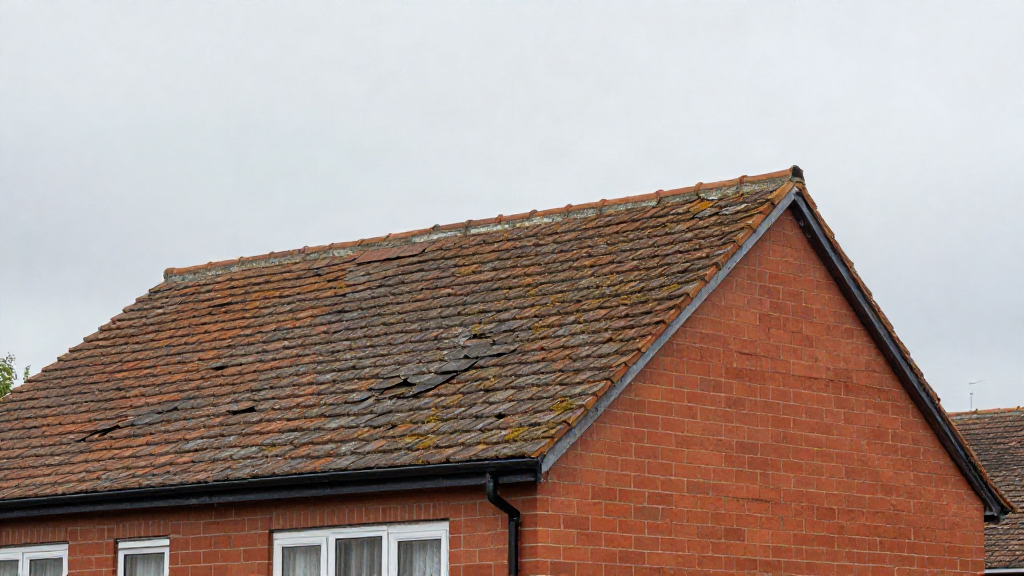
Loose tiles are the most visible signal that a roof is failing. On a pitched roof, tiles and slates are meant to sit tight and overlap in a consistent rhythm. When they start sliding out of line, cracking or disappearing entirely, the weatherproof layer underneath is exposed to every downpour.
A single slipped tile can be re-seated. But when they are coming loose across a whole elevation – or worse, when several have already gone – the fixings and battens beneath are usually past their best. That points towards a full re-roof rather than a running repair.
2. Daylight or damp patches in the loft
Go up into your loft on a bright day and look for pinpricks of light coming through the roof. Any daylight between the rafters means there is a gap in the covering above, and water will find the same route. Damp patches, dark staining on the timbers or a musty smell are the slower, quieter version of the same problem.
Small isolated spots can sometimes be traced and sealed. Widespread light penetration, or timber that is soft and stained across a wide area, tells you the roof has been letting moisture in for a long time.
3. Repeated leaks in the same place
One leak that is properly fixed should stay fixed. If you are calling someone back to the same spot every winter, the problem is not the leak – it is the roof. Water rarely enters where it exits, and on a tired roof it will simply find a new path once the last one is plugged.
For flat roofs this pattern is especially common. A felt roof that has been patched several times rarely holds for long, which is why many Nottinghamshire homeowners eventually move to a Firestone RubberCover EPDM system – a single seamless rubber membrane instead of overlapping layers that can lift and split.
4. A sagging or dipping roofline
Stand across the street and look along the ridge and eaves. A straight, even line is what you want to see. If any part of the roof dips, bows or looks like it is sinking between the walls, the structure beneath is under strain – often from water-damaged timbers or failing supports.
Sagging is not something a new layer of tiles will solve. It needs a proper inspection of the roof structure, and in most cases it means the roof has reached the end of its working life.
5. Granules in the guttering and bald patches on tiles
Concrete tiles are coated with a layer of granules that protects the tile beneath. As tiles age, those granules wash off and collect in the guttering and at the bottom of downpipes. If you are clearing a gritty, sand-like sludge out of your gutters year after year, your tiles are thinning – and bald, pale patches on the roof surface confirm it.
Once the protective layer has gone, tiles become porous and brittle. Replacing them individually rarely keeps pace with the rate they are failing.
6. Moss, algae and rotten fascias or soffits
Heavy moss growth holds moisture against the roof covering and forces tiles apart as it spreads. On its own that can be brushed away, but when moss is combined with crumbling mortar, flaking fascia boards or guttering that has pulled away from the roofline, the water is no longer being carried away from your home as it should be.
Rotten timber fascias and leaking guttering are a fast route to damp walls and damaged brickwork. MTF Roofing installs Freefoam UPVC fascias, soffits and guttering with guarantees of up to 30 years, which removes one of the main causes of premature roof decay.
7. Age: the roof is simply past 25-30 years
Concrete tile and slate roofs are typically expected to last 25 to 30 years before they need replacing, and many homes across Nottingham, Mansfield, Sheffield, Chesterfield, Derby, Worksop and Newark are now well beyond that. If your roof is original to a house built in the 1980s or earlier and you are seeing any of the signs above, you are not dealing with bad luck – you are dealing with the end of the roof’s service life.
What a full re-roof actually involves
A replacement is more straightforward than most homeowners expect. MTF Roofing handles complete re-roofing jobs from start to finish, working around your household with as little disruption as possible.
The process normally runs:
- A full inspection and a free, no-obligation quote
- Removal of the old covering and any failed battens or timbers
- Repairs to the roof structure where needed, then a new breathable membrane
- New battens and a choice of slate, concrete tile or clay tiles to suit your property
- New fascias, soffits and guttering installed at the same time where required
- A full clean-up on completion
Whether your home is detached, a semi, a bungalow or a terrace, the materials and systems we use are chosen and tested for the great British weather.
Repair or replace? Get a straight answer
If you are spotting one or two of the warning signs above, it may well be a repair. If you are spotting several – especially leaks that keep returning and a roofline that has started to move – a re-roof is almost always the better value in the long run.
MTF Roofing is based in Nottinghamshire and covers Nottingham, Mansfield, Sheffield, Chesterfield, Derby, Worksop, Newark and the surrounding areas. We are fully insured, and every job starts with a free quote and honest advice on whether a repair will genuinely hold.
Get in touch for a free, no-obligation quote and find out exactly where your roof stands.