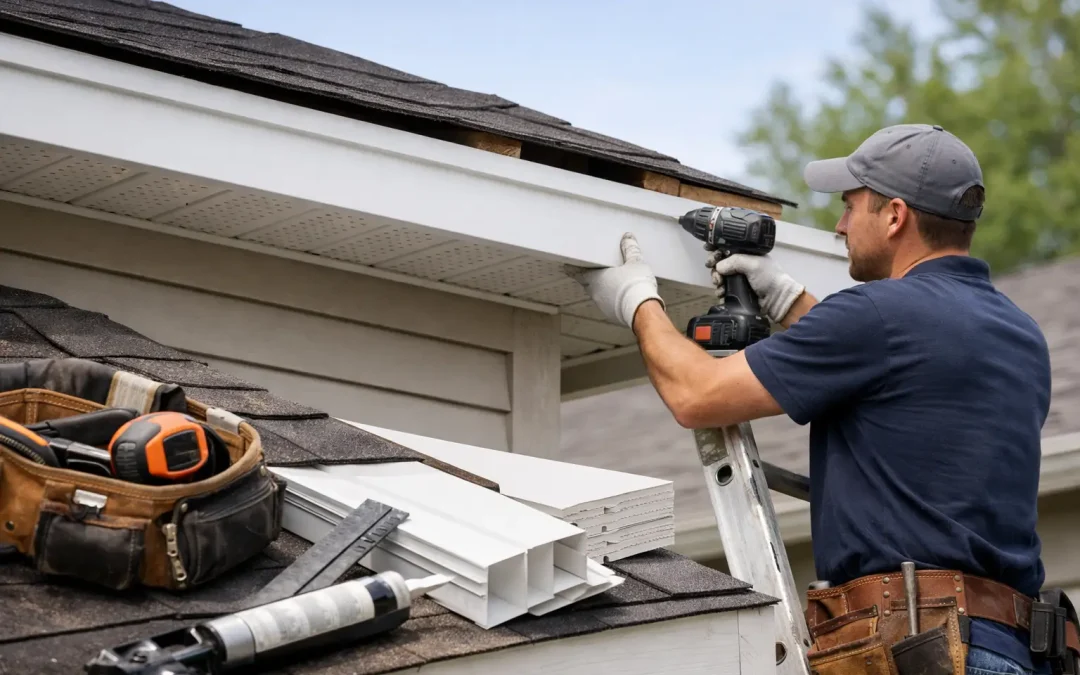
Peeling paint at the roofline, overflowing gutters, or bits of timber starting to look soft after rain usually point to the same problem – your fascias and soffits are no longer doing their job properly. This guide to fascia soffit replacement is designed for homeowners who want clear advice on what needs doing, when it needs doing, and how to avoid paying for poor workmanship.
For many properties, fascia and soffit problems build up slowly. From the ground, the roofline can look mostly fine until water starts getting behind the boards, the guttering begins to sag, or damp patches appear around the eaves. By that stage, replacement is often the sensible long-term option rather than another short-term repair.
What fascia and soffit replacement actually involves
Fascias are the boards fixed along the lower edge of the roof. They support the bottom row of tiles and carry the guttering. Soffits sit underneath the fascia, closing the gap under the roof overhang and helping protect the roof structure from weather, birds, and pests.
When people talk about roofline replacement, they are usually referring to fascias, soffits, guttering, and often the external cladding around the eaves and verges being renewed together. That matters because these parts work as one system. If you replace the guttering but leave rotten fascia boards in place, you are only solving half the problem.
A proper replacement job usually includes removing old boards where needed, checking the timber ends of the rafters, fitting new fascia and soffit boards, adding ventilation if required, and installing new guttering so everything is aligned and draining correctly. On older homes, this can also reveal hidden issues that were not obvious from ground level.
Signs you may need fascia soffit replacement
Some warning signs are easy to spot, while others only become clear during a survey. If paint is flaking every year, boards feel soft, joints are opening up, or gutter brackets are pulling away from the fascia, the roofline may be past basic repair.
Water marks on the outside walls can also point to failing fascias or poorly supported guttering. In some cases, you may notice wasps, birds, or insects getting into gaps around the eaves. Ventilation problems can show up inside the loft as condensation, musty smells, or damp insulation.
Not every issue means full replacement is needed. A localised repair can still make sense if damage is minor and the rest of the roofline is sound. But if the boards are older timber, have widespread rot, or have already been covered over badly in the past, replacement is usually better value than repeated patching.
A guide to fascia soffit replacement materials
Most modern replacements use uPVC because it is durable, low maintenance, and available in a clean finish that suits most homes. It does not need regular painting, it resists rot, and it gives a neater result when fitted properly.
That said, the detail matters. There is a big difference between a full replacement board and a thin capping board fitted over failing timber underneath. Capping can be acceptable in some situations where the original timber is in very good condition, but it is not the right answer if the timber beneath is deteriorating. Covering rotten wood does not fix the cause of the problem, and it can leave hidden defects in place.
Colour choice also plays a part. White remains the most popular option because it suits most properties and keeps the roofline looking bright and tidy. Black, grey, and wood-effect finishes are also common where homeowners want a more modern or more traditional appearance. The best choice depends on the age and style of the property, as well as the look of the windows, doors, and guttering.
Why workmanship matters as much as materials
Roofline replacement is not just a cosmetic job. The boards need to be fixed securely, the guttering has to run at the correct fall, and the installation should allow the roof to breathe properly where ventilation is needed.
Poor fitting standards can create problems that are expensive to put right. Gutters may hold standing water if levels are wrong. Soffits can look uneven if the line is not set out properly. Worse still, if old rotten timber is left in place or the work is rushed, the new roofline may look tidy at first but fail long before it should.
This is why many homeowners prefer a specialist who carries out a proper survey rather than giving a price from a photo alone. A reliable contractor should explain whether they are replacing or overcladding, whether the rafter feet need attention, and whether new ventilation or guttering is included.
How much fascia soffit replacement costs
Cost depends on the size of the property, the access needed, the material chosen, and the condition of the existing roofline underneath. A straightforward replacement on a smaller home is naturally less than a full roofline renewal on a larger detached house with difficult access and extensive timber decay.
The cheapest quote is not always the cheapest job in the long run. If one contractor is allowing for proper removal and full replacement, while another is only pricing to cap over existing boards, the figures may look similar on paper but the standard of work is very different.
A clear quotation should set out what is being replaced, whether guttering and downpipes are included, what waste removal is covered, and whether any repairs to exposed roof timbers are extra if found during the work. That makes it much easier to compare like with like.
Can fascia and soffit replacement be done without changing the guttering?
Sometimes, yes, but often it makes sense to replace both together. The guttering has to come off to carry out the fascia work properly, so if the gutters are already old, brittle, leaking, or poorly aligned, reusing them can be a false economy.
Replacing the roofline as one job also helps achieve a cleaner finish and avoids mismatched materials. On the other hand, if the guttering is relatively new and in good condition, a contractor may be able to remove and refit it. The right answer depends on its age, condition, and how well it suits the new installation.
What to expect during the work
Most domestic fascia soffit replacement jobs are completed over a short period, although timing depends on property size and weather conditions. Access equipment is usually needed so the work can be carried out safely and to a proper standard.
The old roofline is removed or stripped back as required, the structure behind it is checked, and the new boards are fitted in sequence. Guttering is then installed or refitted, joints are sealed where appropriate, and the system is tested to make sure water flows correctly.
A tidy finish matters. So does clean-up afterwards. Homeowners should expect the site to be kept orderly, waste to be removed, and the completed roofline to look straight, secure, and in keeping with the property.
Choosing the right contractor for the job
A good fascia soffit replacement job should leave your home better protected and better presented for years to come. That means choosing a contractor based on more than just price.
Look for clear communication, proof of insurance, solid local reviews, and a straightforward explanation of what is included. Ask whether the company handles surveys, fitting, and clean-up directly. Ask whether they replace rotten timber where needed rather than covering it up. Ask how they ensure the guttering is supported properly.
For homeowners across Nottingham and the wider Midlands, that practical, no-nonsense approach is often what separates a dependable roofing firm from one that simply wants to get in and out quickly.
When replacement is worth doing now
It is tempting to put roofline work off until there is obvious damage, especially if the problem seems minor. But if the fascias and soffits are already failing, waiting can allow water to affect the roof structure, brickwork, and internal areas near the eaves.
Replacing them at the right time protects the property and freshens up its appearance at the same time. It can also save the ongoing cost of repainting old timber or repeatedly repairing guttering that no longer has a sound fixing point.
If you are unsure whether your home needs a repair or a full replacement, a proper site survey is the best place to start. Honest advice should tell you what condition the roofline is really in and what work will give you a result that lasts. Done properly, fascia and soffit replacement is not just a tidy-up job – it is part of looking after your home the right way.