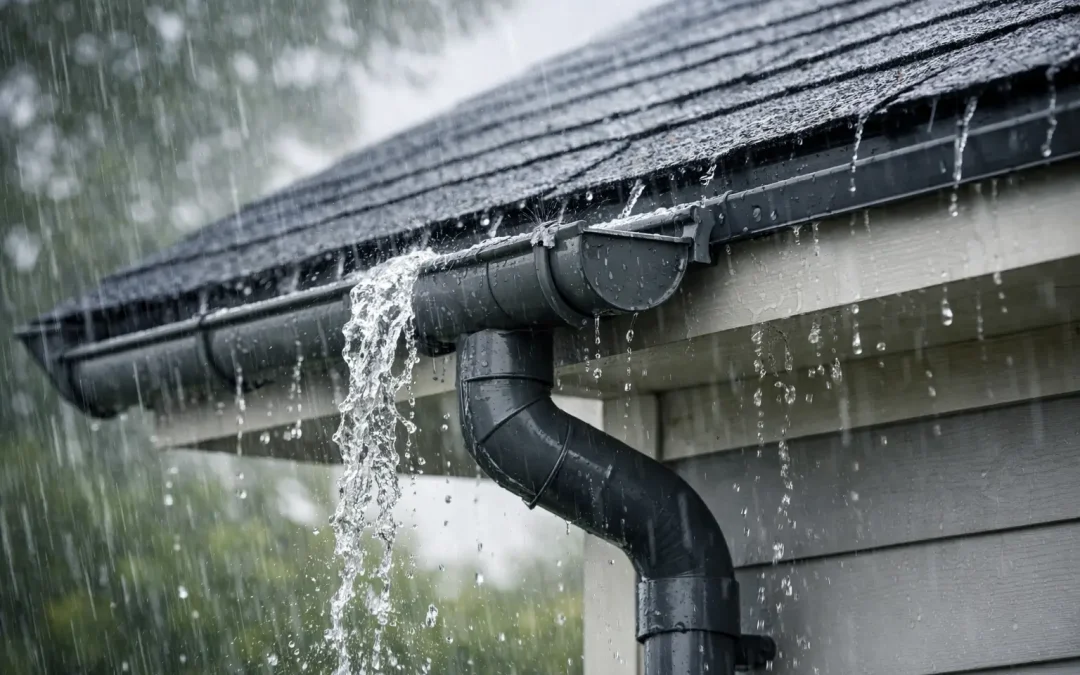
A heavy Midlands downpour can expose weak guttering in minutes. Water overflowing at the eaves, splashing against brickwork or running down a wall is more than an inconvenience – it can lead to damp, damaged pointing and problems around fascias and soffits. The best guttering for heavy rain is not simply the largest system available. It is the right combination of gutter profile, capacity, downpipes and professional fitting for the roof on your home.
For many properties, guttering is only noticed when it fails. A well-designed system should move rainwater away quietly and reliably, protecting the roofline and directing it safely into the drainage system. Getting the specification right at replacement stage is far less disruptive than dealing with the damage caused by repeated overflow.
What makes guttering suitable for heavy rain?
Guttering has one job: collect water from the roof and carry it to the downpipes without spilling over. In periods of intense rain, its performance depends on more than the gutter itself. The size and pitch of the roof, the number of valleys, the gutter run, nearby trees and the position of downpipes all affect how much water needs to be handled.
A small roof with a straightforward slope may perform well with standard domestic guttering. A larger detached home, an extension with a flat roof, or a roof where two slopes meet in a valley can send a much greater volume of water into one section. If the existing system regularly overflows despite being clear of leaves, it may be undersized or have too few outlets.
The fall of the gutter is equally important. Gutters need a slight, consistent slope towards the downpipe. Too little fall can leave standing water and debris; too much can make water run past the outlet during very heavy rainfall. Correct bracket spacing matters too. A gutter that sags between brackets can hold water, pull away from the fascia and lose its intended fall.
Best guttering for heavy rain: profiles and materials
For most homes in Nottingham and the wider Midlands, high-quality uPVC guttering is a practical and dependable choice. It is durable, low maintenance, does not rust and is available in colours that complement modern or traditional rooflines. The key decision is usually the profile and capacity rather than moving to an unnecessarily expensive material.
Deepflow guttering
Deepflow guttering has a deeper profile than a standard half-round gutter, allowing it to carry more water. It is often one of the best options for heavy rain on larger homes, properties with broad roof slopes and areas where standard guttering has struggled to cope.
It offers good capacity without looking excessively bulky on most properties. When correctly supported and paired with suitable downpipes, it provides a sensible upgrade for homeowners who want stronger rainwater performance while keeping a neat, familiar appearance.
Ogee guttering
Ogee guttering has a shaped front edge that gives a more decorative finish. It can offer good water capacity, particularly in deeper systems, and is popular where homeowners want the roofline to look more traditional or detailed.
Its suitability depends on the specific product and the roof it serves. A quality ogee system can work well in heavy rain, but appearance should not be the only deciding factor. The gutter must still have enough capacity and sufficient downpipe provision for the water coming off the roof.
Half-round guttering
Half-round guttering remains common on many homes. It is simple, tidy and can be perfectly adequate for smaller roofs with uncomplicated drainage. However, it has less capacity than a deepflow system, so it may not be the best choice where overflow is already an issue.
Replacing like-for-like can be tempting, particularly if the guttering has lasted many years. But if water has repeatedly spilled over during storms, fitting the same size again may only repeat the problem. An experienced survey should consider whether an upgrade is needed before the new system is installed.
Square-line guttering
Square-line guttering has a more angular appearance and can provide useful capacity. It suits many modern properties and can be an effective option where the roofline design calls for a clean, straight finish. As with every profile, performance comes down to proper sizing, accurate falls and correctly positioned outlets.
Metal guttering, including aluminium or cast iron, may suit certain period properties or projects where a particular appearance is required. These materials can be long-lasting, but they usually involve a higher cost and may require more specialised maintenance or installation. For many residential homes, a high-spec uPVC system fitted properly offers excellent value and dependable day-to-day performance.
Downpipes are just as important as the gutters
A large gutter feeding into a restricted or poorly placed downpipe can still overflow. Downpipes need to take water away as quickly as the gutter collects it. On larger roofs, adding an extra downpipe can be more effective than relying on one outlet at the end of a long run.
Valleys deserve particular attention. They concentrate water from two roof slopes into one point, creating a fast flow during heavy rain. The gutter beneath a valley may need a larger outlet, a deeper profile or an additional downpipe arrangement. This is not an area for guesswork, as repeated overspill can soak the fascia, soffit and brickwork below.
The connection at ground level also needs checking. If a downpipe empties into a blocked gully or a drain that cannot take the volume of water, the problem has simply moved lower down the property. A proper installation considers the full route from roof edge to drainage point.
Signs your present guttering is not coping
Overflowing in exceptional weather does not always mean the guttering is wrong. A sudden cloudburst can test any domestic system. However, regular problems during ordinary heavy rain should be investigated.
Common warning signs include water running over the front edge of the gutter, damp staining on external walls, peeling paint around the roofline, dripping joints, sagging lengths and persistent pools of water near downpipes. You may also see staining or green growth on the brickwork beneath a gutter joint, which can indicate a slow leak rather than a capacity problem.
Blocked gutters are a frequent cause, especially where there are overhanging trees. Leaves, moss from the roof and wind-blown debris can obstruct outlets and downpipes. Clearing them may restore performance, but cleaning alone will not resolve guttering that is too shallow, poorly angled or inadequately supported.
Why fitting quality matters
Even the best gutter profile will not perform properly if it is fitted without care. Brackets should be fixed securely at the correct spacing, with a planned fall towards each outlet. Joints need to be correctly assembled and allowed for normal movement in changing temperatures. Fascias must also be sound enough to support the system.
This is particularly relevant when replacing old timber fascias and soffits. If the timber behind the existing roofline has deteriorated, simply fixing new gutter brackets into weak material can lead to movement and failure later. A thorough inspection should identify any repairs needed before the new guttering goes on.
At MTF Roofing Ltd, guttering work is assessed as part of the wider roofline, not treated as a quick fix. Looking at the condition of the fascias, soffits, roof edge and drainage helps ensure the finished work is both tidy and built to last.
Choosing the right system for your home
The right choice depends on the property rather than a single product label. A standard semi-detached home with clear, short gutter runs may only need a well-fitted quality uPVC replacement. A larger detached property, a home with a rear extension, or a roof with several valleys may benefit from deepflow guttering and additional downpipes.
Colour is worth considering as well. Black, white, anthracite grey and brown are common options, and matching the guttering to the fascias, soffits, windows or roof tiles can make a noticeable difference to the exterior. That said, capacity and fitting should come first. A smart-looking gutter system that overflows is not doing its job.
A site survey gives the clearest answer. It allows the installer to measure runs, assess roof drainage points, check the condition of the existing roofline and recommend a system that suits both the property and the budget. Homeowners should expect a clear explanation of what is being fitted and why, rather than being pushed towards a one-size-fits-all replacement.
Heavy rain is unavoidable, but water damage does not have to be. If your gutters overflow, sag or leak, arrange an inspection before the next spell of wet weather turns a manageable roofline issue into a repair to the walls or roof below.