
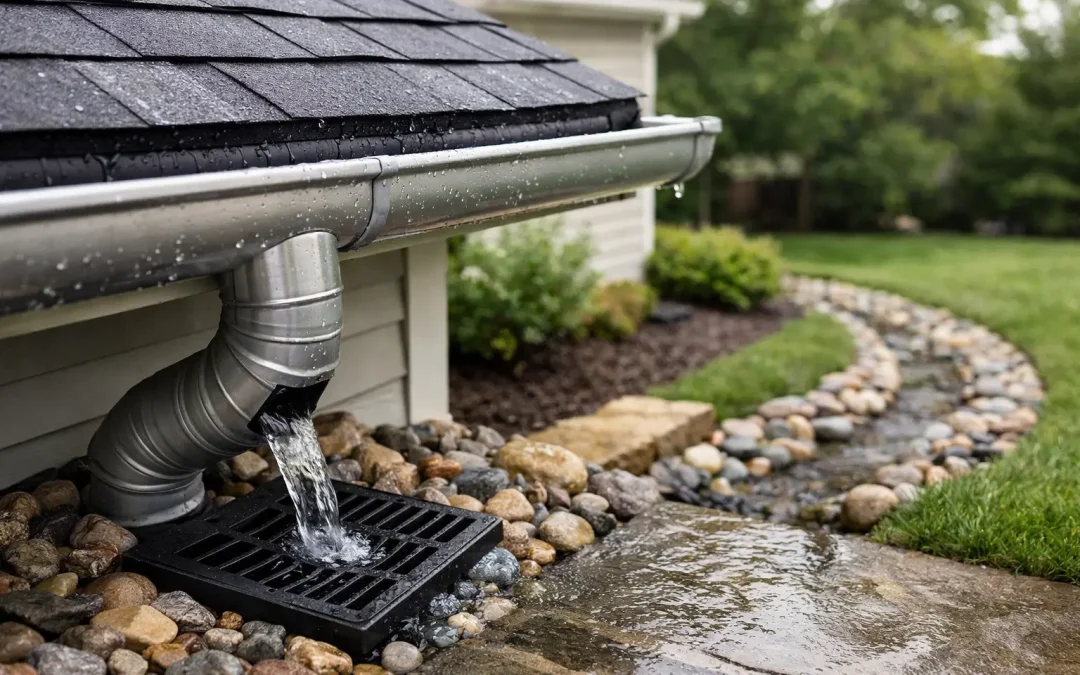
Water should leave your roof quickly, cleanly and well away from your property. When it does not, the warning signs are often easy to spot: overflowing gutters in heavy rain, damp patches on external walls, green staining, water running behind the guttering, or puddles close to the foundations. Knowing how to improve roof drainage can prevent small maintenance issues from becoming expensive repairs to your roof, roofline or brickwork.
For most homes, better drainage does not start with a major roofing project. It starts with finding where the water is being held up, redirected or allowed to escape in the wrong place. A careful inspection after rainfall can tell you far more than looking at the roof on a dry day.
Start with clear, correctly fitted guttering
Gutters are the first part of the drainage system to check. Leaves, moss, twigs and roof grit collect in them over time, particularly on properties near trees. Once debris builds up around an outlet, rainwater has nowhere to go and starts overflowing over the front or back edge of the gutter.
Clearing gutters regularly is one of the simplest ways to improve drainage. For many homes, an inspection in spring and again in late autumn is sensible. If your property is beneath overhanging trees, you may need to check them more often. Do not assume a gutter is clear because water is not visibly overflowing on a dry day.
The gutter also needs the right fall. It should slope gently towards the downpipe so water moves away rather than sitting in long stretches. Sagging brackets, loose joints and sections that have been fitted unevenly can leave standing water in the gutter. This adds unnecessary weight, encourages dirt to settle and can eventually cause joints to fail.
Old guttering does not always need full replacement. A loose bracket or leaking union can often be repaired. However, cracked plastic, badly distorted lengths or guttering that repeatedly holds water may be better replaced as part of a proper roofline upgrade. A repair that looks cheaper at first can become poor value if the system continues to leak every winter.
Check downpipes from top to bottom
A clean gutter will still overflow if its downpipe is blocked. Debris commonly gathers at the outlet where the gutter meets the pipe, but blockages can also form at bends or near the bottom of the downpipe. During rain, look for water backing up at the outlet or spilling from the top of the gutter near the pipe.
Downpipes should be securely fixed to the wall and connected properly at each joint. A pipe that has come loose can direct a steady flow of water onto brickwork or a window ledge. Over time, this can leave staining, contribute to damp and affect the appearance of the property.
Pay attention to where the downpipe discharges. Water should enter a working drain, soakaway or suitable surface-water system, not simply empty beside the house. If the gully is full of silt, leaves or moss, clear it so rainwater can move away. Where a drain regularly backs up, the issue may be below ground rather than with the roof itself, and it is worth having the drainage investigated.
Make sure water is not getting behind the gutter
Water running behind guttering is a common problem that is not always visible from ground level. It can happen when the gutter has been set too low, when a roof edge has deteriorated, or when the eaves detail does not guide water into the gutter correctly.
On pitched roofs, felt support trays and eaves protection help direct water off the roof and into the gutter. If the roofing felt has rotted back or dropped, rain can track behind the gutter and soak the fascia board. Timber fascias are particularly vulnerable, but water behind any roofline can cause hidden damage if left untreated.
Signs include peeling paint on timber, soft fascia boards, black staining beneath the gutter line and drips appearing from the soffits. These are not problems to cover over with new paint. The source of the water needs to be corrected first, then any damaged roofline components can be repaired or replaced properly.
Keep valleys, roof channels and flat roofs clear
Not all roof drainage relies on straightforward gutter runs. Roof valleys, where two roof slopes meet, carry a high volume of water towards the eaves. Moss, leaves or slipped tiles in a valley can slow the flow and allow water to find its way beneath the roof covering.
A flat roof needs particular attention because it does not shed water as quickly as a pitched roof. A well-fitted flat roof should have a planned fall towards its outlets or gutters. Small amounts of water may remain briefly after heavy rainfall, but water that sits for days is known as ponding and should be checked. It can point to a blocked outlet, a low area in the roof, failed covering or inadequate falls.
Do not try to solve persistent ponding by adding sealant around the area. The lasting solution depends on the cause. A blocked outlet may be straightforward to clear, while a roof with poor falls may need alteration or replacement. A professional survey will establish whether the waterproof covering remains sound and whether the water is placing the roof at risk.
Consider gutter capacity, not just condition
Sometimes guttering is clear, securely fitted and still cannot cope during a downpour. This is more likely on larger roof areas, steep roofs, extensions, conservatories or properties where several roof slopes feed into one short gutter run.
Larger-capacity guttering or extra downpipes can make a real difference where the existing system is undersized. The best arrangement depends on the roof area, the location of valleys and the route water needs to take to reach the ground drainage. Adding a downpipe without considering the underground drain, for example, may simply move the overflow problem elsewhere.
This is also why it is worth being cautious with gutter guards. They can reduce leaf build-up in some settings, but poorly chosen guards may trap moss and roof debris on top, making cleaning more difficult. They are most useful when matched to the property and maintained rather than treated as a fit-and-forget solution.
Look beyond the roof edge
Improving roof drainage also means protecting the ground around the property. Water discharged too close to the walls can saturate the soil and increase the risk of damp at low level. Check that paths, patios and garden areas fall away from the house where possible, and keep air bricks clear of soil, gravel and leaves.
If you have a water butt connected to a downpipe, make sure its overflow is working. A full butt without a proper overflow can force water back up the downpipe during heavy rain. It is a useful way to collect water for the garden, but it still needs to form part of a drainage system that works in poor weather.
Know when to call a roofing professional
Routine checks from ground level are sensible, but roof and gutter work can be unsafe without the right access equipment. Ladders should not be used on uneven ground, in wet or windy conditions, or for work that requires you to overreach. A fall from even a modest height can have serious consequences.
Arrange a professional inspection if you see repeated overflowing, water behind the gutter, damaged fascias or soffits, sagging gutters, leaks near the eaves, persistent standing water on a flat roof, or signs of damp inside the loft. These problems are often connected, and treating only the visible symptom can leave the underlying fault untouched.
At MTF Roofing Ltd, we assess the condition of the roof, guttering and roofline as a whole, then explain the work needed in plain terms. Whether the answer is a gutter repair, replacement downpipe, new fascias and soffits, or attention to a flat roof, the aim is the same: move rainwater safely away from your home and keep it there.
A roof drainage system works quietly when it is doing its job. Give it regular attention, act on the first signs of overflow, and you will be far more likely to protect the parts of your home that rainwater can damage slowly and expensively.