
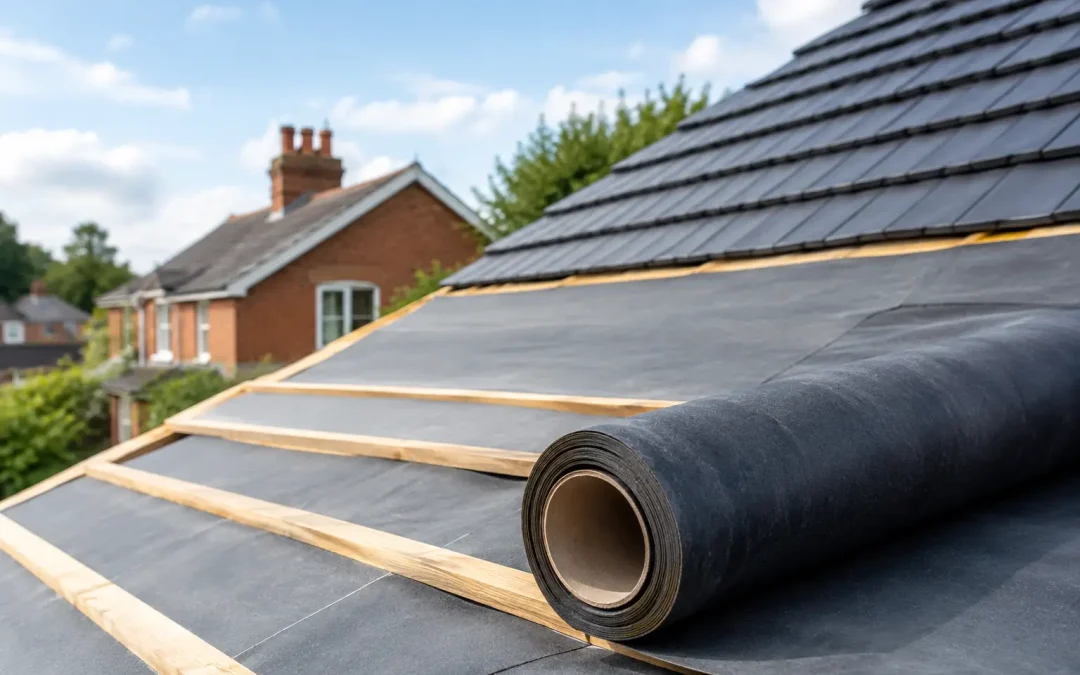
A roof can look sound from the street while the layer beneath its tiles is doing far more work than most homeowners realise. The best roof underlay options help manage wind-driven rain, dust, condensation and small amounts of water that may get past the outer roof covering. Choosing the wrong type, or fitting a good product badly, can leave a roof vulnerable long before the tiles themselves need replacing.
For homes across Nottingham and the Midlands, the right choice depends on the roof structure, covering, ventilation and the condition of the existing roof. Underlay is not a substitute for properly fitted tiles, slates, flashings or ridge work. It is an important second line of defence that needs to work with the whole roof system.
What roof underlay actually does
Roof underlay sits beneath tiles or slates and above the rafters or roof decking. It helps protect the loft space and roof timbers when rain is driven beneath the outer covering by strong winds. It can also reduce draughts and keep dust, insects and debris from entering through gaps in the roof covering.
Its other key role is moisture management. Warm air from the house naturally rises, and if moisture-laden air reaches a cold roof space it can form condensation. A suitable underlay, combined with the correct ventilation where required, helps moisture escape rather than allowing it to build up around timbers and insulation.
This is why underlay should never be selected on price alone. The cheapest material may be suitable for a small repair in the right circumstances, but a full re-roof is the time to fit a system that will serve the property properly for years to come.
Best roof underlay options for pitched roofs
Breathable roofing membrane
For many modern tiled and slated roofs, a breathable membrane is the preferred option. It is designed to resist water from outside while allowing water vapour from within the roof construction to pass through. This makes it a practical choice for helping to control condensation in a well-designed pitched roof.
Breathable membranes are lightweight, straightforward to handle and commonly used during re-roofing work. They offer good protection while the roof is being installed, which is particularly useful when the British weather is less than predictable. Once covered with tiles or slates, they provide a dependable backup layer against rain blown under the roof covering.
However, breathable does not mean ventilation can be ignored. The roof must still be assessed as a complete system. The pitch, insulation position, eaves detail, ridge ventilation and the manufacturer’s installation guidance all matter. A membrane pulled too tight, left sagging excessively or detailed poorly around penetrations will not perform as it should.
Traditional bituminous felt
Bituminous felt is a familiar material found beneath many older roofs. It is generally more resistant to water vapour than a modern breathable membrane, so it relies more heavily on effective ventilation above and below the material to prevent condensation problems.
There are situations where felt remains appropriate, particularly where it matches an existing roof design or is specified for a particular construction. It can be durable and provides a strong barrier against water ingress. Yet it is heavier and less forgiving than many modern membranes, and a roof using it needs careful ventilation planning.
If an older roof is being repaired rather than fully replaced, it is often sensible to retain compatible materials where possible. If the roof is being stripped back for a complete re-roof, the decision should be based on the property’s current construction and performance needs, not simply on what was fitted decades ago.
Reinforced underlay for exposed locations
Some homes need more than a standard approach. Properties on high ground, in open rural areas or on exposed streets can face repeated wind pressure and driving rain. A reinforced underlay or higher-performance membrane may be appropriate where the roof covering is likely to experience tougher conditions.
The underlay alone does not make a roof weatherproof. Tile fixings, batten quality, verge details, leadwork and the condition of ridges and valleys are equally important. Still, using a product suited to exposure gives the roof an added margin of protection where it is most needed.
Vapour control layers for warm roof construction
A vapour control layer is different from the underlay used beneath tiles. It is usually fitted on the warm side of the insulation, inside the roof build-up, to limit warm moist air travelling into colder parts of the structure.
This detail is especially relevant in insulated roof conversions and some warm roof designs. It should not be treated as an interchangeable replacement for breathable membrane. Both products can be necessary, but they perform different jobs and must be positioned correctly.
Roof type affects the right choice
The covering above the underlay has a direct effect on the specification. Concrete tiles, clay tiles and natural slate each have different weights, fixing methods and expected gaps. A low-pitched roof may need more careful consideration than a steeper roof because water sheds more slowly and wind-driven rain can be more of a concern.
Slate roofs deserve particular attention. Natural slate can last for generations when properly maintained, but the underlay beneath it may reach the end of its life sooner. If a slate roof needs widespread repairs and the underlay is brittle, torn or failing, lifting and reusing suitable slates as part of a full renovation can be a better long-term answer than carrying out repeated small repairs.
For a standard tiled re-roof, breathable membrane is often the sensible modern choice. That said, the correct product grade and fitting method will depend on the roof pitch, location and ventilation arrangement. A survey should establish these details before work begins.
Do flat roofs use roof underlay?
Flat roofs are built differently. A rubber flat roof, felt flat roof or other waterproof covering is usually installed as part of a layered system over a roof deck and insulation. The weatherproof membrane is the main external barrier, rather than an underlay beneath tiles.
Some flat roof systems include separation layers, vapour control layers or protective sheets, but these should be chosen as part of the approved system rather than picked individually. Mixing unsuitable materials can affect adhesion, drainage and the lifespan of the finished roof.
If a flat roof is leaking, the problem may be the covering, failed edge trims, poor falls, damaged flashing or trapped moisture beneath the surface. Adding a layer without identifying the cause rarely provides a lasting repair.
Signs the existing underlay may be failing
Underlay is hidden, so the first warning signs are often seen inside the loft or around the roofline. A professional inspection can confirm the cause, but homeowners should not ignore damp patches on rafters, repeated water marks after heavy rain, torn material visible between tiles, or daylight showing where it should not.
Other signs include persistent loft condensation, mould around roof timbers, sagging felt, perished material that crumbles when touched, and water entering despite tiles appearing largely intact. These issues do not always mean a full re-roof is needed. A slipped tile or damaged flashing can create similar symptoms. The important point is to find the source rather than guessing.
Why fitting quality matters as much as the material
Even the best membrane can fail to do its job if laps are too small, tears are left unrepaired, penetrations are not sealed correctly or the eaves are poorly detailed. Underlay must direct any water safely towards the gutter line, not allow it to run behind fascias or into the roof space.
The condition of the supporting work matters too. Rotten battens, inadequate tile fixings and worn fascias can undermine a new roof covering. During a re-roof, it makes sense to inspect these details while access is available, rather than covering over faults that may lead to further disruption later.
At MTF Roofing Ltd, the focus is on assessing the full roof rather than treating underlay as an isolated item. Clear advice should explain what needs replacing, what can be retained and why the recommended materials suit the property.
Making a sensible choice for your home
For most homeowners, a high-quality breathable membrane fitted as part of a properly ventilated tiled or slate roof offers a reliable balance of protection and moisture control. Traditional felt can still be suitable in the right roof design, while exposed properties or specialist constructions may need a more specific product and installation method.
The best decision starts with a close inspection of the roof, loft space and existing materials. If you are planning a re-roof or have concerns about leaks and condensation, ask for the proposed roof build-up to be explained in plain terms. A contractor who takes the time to do that is far more likely to leave you with a roof that looks right, drains properly and protects your home when the weather turns.